


OR call us at 602-456-6085 today.

Schedule a consultation with an experienced Glendale, AZ debt relief lawyer today.
If mounting debt obligations have made it increasingly difficult to cover essential household expenses alongside minimum balance payments, the financial pressure is unlikely to resolve without intervention. Unpaid balances continue to grow as interest compounds and late fees accrue with each billing cycle. Collection activity may intensify over time, and creditors who are not receiving payment can pursue legal remedies, including civil lawsuits, wage garnishment, and bank account levies.
Wright Law Offices has helped Arizona residents resolve overwhelming debt for more than 10 years. Our Glendale, AZ debt relief lawyer evaluates your full financial situation, identifies the legal options that apply to your specific circumstances, and recommends the strategy most likely to produce a sustainable outcome. Schedule a free consultation to discuss your situation.
Debt Relief Lawyer Glendale, AZ
A debt relief lawyer helps individuals and families who can no longer meet their financial obligations find a legal path forward. That path may involve filing for bankruptcy to discharge qualifying debts entirely, negotiating settlements with creditors for less than the full balance owed, or restructuring obligations through a court-supervised repayment plan. The right approach depends on what kind of debt is involved, how much is owed, what the client earns, and what assets need to be protected.
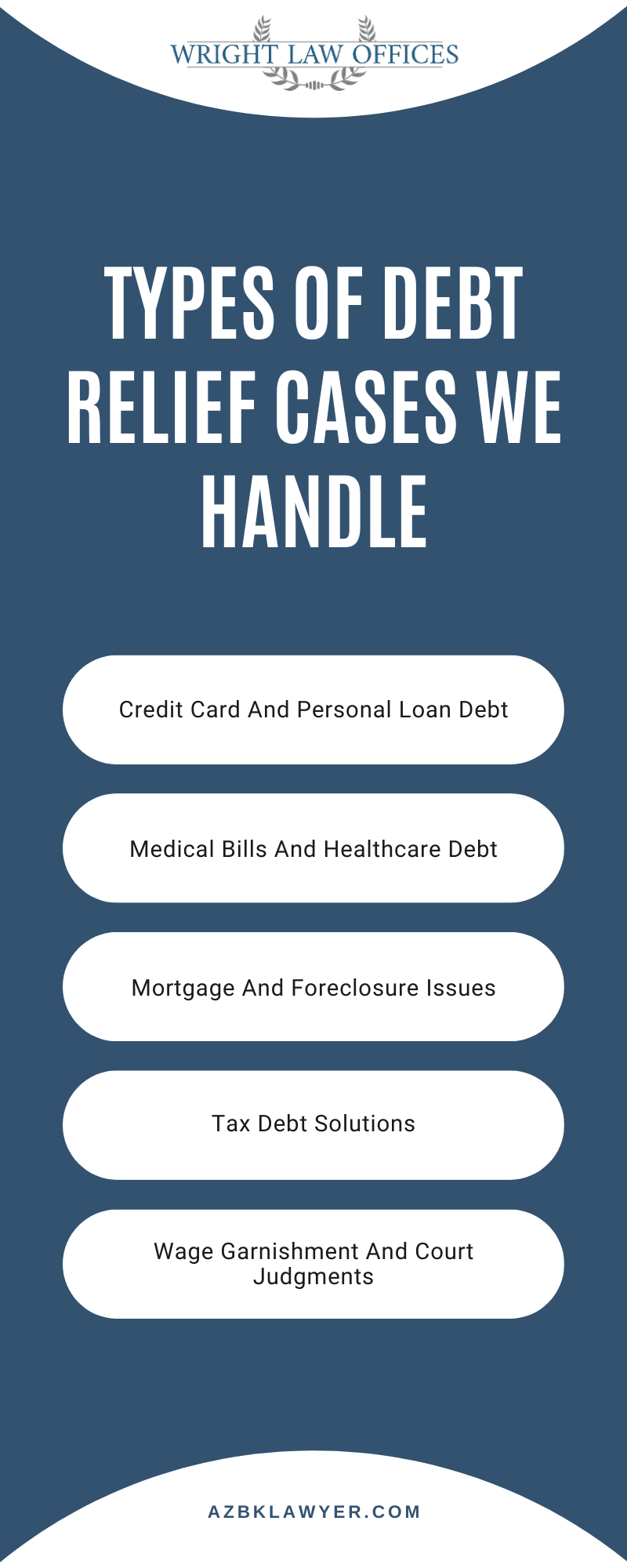
Types of Debt Relief Cases We Handle in Glendale
Individuals who contact our Glendale, AZ office carry debt that has accumulated from a broad range of sources and circumstances.
- Chapter 7 Bankruptcy. Chapter 7 eliminates most unsecured debts, including credit card balances, medical bills, personal loans, and certain older tax obligations. The process typically takes three to four months from filing to discharge. Eligibility requires passing a means test that compares the debtor’s household income to the Arizona median for the same household size. For clients who qualify, Chapter 7 provides the fastest and most complete form of debt relief available under federal law.
- Chapter 13 Bankruptcy. Chapter 13 allows debtors with regular income to repay a portion of their obligations through a court-approved plan lasting three to five years. At the end of the plan, remaining qualifying balances are discharged. Chapter 13 is particularly valuable for homeowners who need to cure mortgage arrears or vehicle loan defaults while managing unsecured debt at the same time. It also serves clients whose income exceeds the Chapter 7 means test threshold.
- Credit Card Debt Resolution. Credit card balances represent the single most common type of debt our clients carry. High interest rates cause balances to grow rapidly even when the cardholder is making minimum payments, and creditors will eventually charge off the account and assign it to a collection agency or file suit. We pursue resolution through bankruptcy discharge, negotiated settlements, or structured repayment depending on the client’s broader financial circumstances.
- Medical Debt Relief. A single hospitalization or emergency procedure can generate bills that exceed a year’s income. Medical debt is fully dischargeable in both Chapter 7 and Chapter 13 bankruptcy. For clients who do not want to file or who do not qualify, we negotiate directly with providers and collection agencies to reduce the balance or establish a manageable payment arrangement.
- Wage Garnishment. Arizona law allows creditors who obtain a court judgment to garnish up to 25 percent of a debtor’s disposable earnings. That reduction in take-home pay is often the event that makes an already difficult financial situation completely untenable. Filing for bankruptcy triggers the automatic stay, which stops garnishment immediately and remains in effect while the case is pending.
- Foreclosure. When debt accumulation leads to missed mortgage payments, the risk of losing the home becomes real. We file Chapter 13 petitions to halt pending trustee’s sales and create a structured path to cure the mortgage default over time, while simultaneously addressing the unsecured debt that contributed to the problem.
- Tax Debt. IRS and Arizona state tax obligations carry collection powers that exceed those of private creditors, including the ability to levy wages and seize bank accounts without a court order. Certain income tax debts that meet strict timing and filing requirements can be discharged in bankruptcy. Others must be repaid through a plan or resolved through negotiation with the taxing authority.
- Debt Settlement Negotiation. For clients who prefer to avoid bankruptcy or who carry a limited number of accounts, direct negotiation with creditors can produce settlements for less than the full balance owed. We handle communication with creditors and collection agencies, negotiate lump-sum or structured settlement terms, and document the resolution to protect the client from future collection on the same obligation.
- Lawsuit and Judgment Defense. Creditors who file lawsuits and obtain default judgments gain access to garnishment, bank levies, and property liens. Filing for bankruptcy before or after a judgment is entered can discharge the underlying debt and remove the lien in many cases. We evaluate the status of any pending or completed lawsuits as part of the overall debt relief strategy.
Why Choose Wright Law Offices as My Debt Relief Lawyer in Glendale, AZ?
Results for Glendale Clients
Wright Law Offices has discharged hundreds of thousands of dollars in unsecured debt for clients across Glendale and the greater Phoenix area through Chapter 7 and Chapter 13 filings. We have stopped active wage garnishments within days of filing, negotiated settlements that reduced outstanding balances by significant percentages, and structured Chapter 13 plans that allowed homeowners to save their properties while eliminating qualifying unsecured obligations after the plan. Our success in Glendale reflects the firm’s sustained commitment to thorough preparation and consistent communication at every stage of the debt relief process.
Attorney Background and Approach
Benjamin Wright earned his J.D. from the University of Wisconsin Law School and is licensed to practice in Arizona and Wisconsin, with admission to the U.S. Bankruptcy Court for the District of Arizona. He has spent over a decade concentrating on bankruptcy and debt resolution, and that sustained focus means he has encountered virtually every combination of debt type, income level, and asset profile that a Glendale resident might present.
We approach each debt relief case by assessing the client’s entire financial position rather than looking at any single obligation in isolation. A client who owes $50,000 in credit card debt may also be behind on property taxes, facing a garnishment, and two months late on the mortgage. Treating those as separate problems produces separate solutions that often conflict with one another. Treating them as one interconnected financial picture produces a single strategy that addresses all of them. As a bankruptcy lawyer in Glendale, AZ, he connects each element of a client’s debt situation to the resolution path that best serves their long-term financial stability. Wright Law Offices provides free consultations to every Glendale resident considering debt relief.
Glendale Debt Relief Infographic
What Is Important to Understand About Debt Relief Cases?
Debt Relief Options and How They Work
Glendale residents carrying unmanageable debt have several legal options. The challenge is that the best option for one person may be entirely wrong for another. Income, asset ownership, the types of debt involved, and whether any creditor has already filed suit all affect the analysis.
- Chapter 7 Discharge. Most unsecured debts are eliminated. The debtor surrenders any non-exempt assets to the bankruptcy trustee, though the majority of Chapter 7 cases in Arizona are “no-asset” cases, meaning the debtor keeps everything they own because it falls within the state’s exemption protections. The process takes roughly three to four months.
- Chapter 13 Repayment Plan. The debtor makes a single monthly payment to the bankruptcy trustee, who distributes it among creditors according to the court-approved plan. Unsecured creditors typically receive only a fraction of what they are owed. At the end of the plan, remaining qualifying balances are discharged. The plan lasts three to five years depending on the debtor’s income relative to the state median.
- Debt Settlement. The creditor agrees to accept less than the full balance, usually in exchange for a lump-sum payment or a short series of payments. Settlements are negotiated on an account-by-account basis. Not every creditor will agree, and the tax consequences of forgiven debt should be understood before any settlement is finalized.
- Debt Consolidation. Outstanding balances are combined into a single payment, often through a new loan or a structured program. Consolidation does not reduce the total amount owed. It simplifies the payment structure and may lower the effective interest rate. We evaluate whether consolidation actually improves the client’s position or simply extends the timeline without meaningful relief.
- Creditor Harassment and Collection Defense. Federal law under the Fair Debt Collection Practices Act restricts how collection agencies can contact debtors. Violations are actionable. Filing for bankruptcy stops all collection activity through the automatic stay.
What Are Important Aspects of a Debt Relief Case?
Several variables determine which debt relief strategies will produce the most favorable outcome for a given client.
The composition of the debt matters as much as the total. Credit card balances, medical bills, and personal loans are treated differently in bankruptcy than student loans, child support arrears, or recent tax obligations. Some debts are dischargeable. Others are not. Knowing which category each obligation falls into is the starting point of every viable strategy.
Income relative to household size determines Chapter 7 eligibility. Arizona uses the Census Bureau median income figures to apply the means test. A household that exceeds the threshold may still qualify for Chapter 7 under certain circumstances, but the analysis becomes more detailed.
Whether any creditor has already obtained a judgment changes the urgency. A judgment creditor can garnish wages, levy bank accounts, and record liens against real property. Filing for bankruptcy before those collection actions are executed prevents them. Filing after they have begun can stop them and, in many cases, reverse them.
Asset ownership affects the strategy as well. Arizona’s bankruptcy exemptions protect a homestead, personal property up to specified dollar amounts, retirement accounts, and other categories of assets. Understanding what is protected and what is not determines whether Chapter 7 is safe for the client or whether Chapter 13 provides a better framework.
The client’s stated objectives are central to the strategy we recommend. Certain clients seek to discharge every eligible obligation and establish a clean financial foundation. Others intend to retain a home or a vehicle and require a plan that resolves the debts preventing them from maintaining those payments. In every case, the resolution strategy is built around the outcome the client is working to achieve.
What Is the Debt Relief Case Timeline?
The timeline for resolving a debt relief case depends on the strategy selected and the complexity of the client’s financial situation.
- The process begins with a consultation where we review all outstanding obligations, income, monthly expenses, and assets to determine which strategies apply.
- If Chapter 7 is the chosen path, the debtor completes a credit counseling course, and the petition is typically filed within two to four weeks. The 341 meeting of creditors occurs approximately 30 to 45 days after filing. Discharge follows roughly 60 days after the meeting, placing the total timeline at three to four months.
- If Chapter 13 is selected, the petition is filed on a similar timeline. The repayment plan is proposed and, after a confirmation hearing, approved by the court. The plan lasts three to five years. Discharge occurs upon successful completion.
- Debt settlement timelines vary by creditor. Some negotiations conclude within weeks. Others, particularly with larger institutional creditors, take several months.
- Clients facing active garnishment or a pending lawsuit often need the bankruptcy petition filed on an expedited basis. In urgent situations, we can prepare and file the petition within days of the initial consultation.
What Should You Bring to Your Debt Relief Consultation?
Arriving with your financial records organized allows us to provide a more accurate and actionable assessment during the initial meeting.
- A list of all outstanding debts, including creditor names, approximate balances, and whether any account is in collections or subject to a lawsuit
- Proof of income for all household members, including recent pay stubs, the most recent two years of tax returns, and documentation of any benefits or supplemental income
- A written monthly budget that accounts for housing, utilities, transportation, food, insurance, and minimum debt payments
- Any court documents related to pending lawsuits, judgments, or garnishment orders
- Documentation of major assets, including the estimated value of your home, vehicles, retirement accounts, and bank account balances
We review these records during the consultation at our Glendale office and outline the debt relief strategies that apply to your financial circumstances.
What Are Important Arizona Legal Resources for Debt Relief Cases?
Arizona residents dealing with unmanageable debt can access several government and institutional resources for general information on their rights, available programs, and the bankruptcy process.
- The U.S. Bankruptcy Court for the District of Arizona publishes filing procedures, required forms, and general guidance for individuals considering Chapter 7 or Chapter 13 bankruptcy.
- The Consumer Financial Protection Bureau provides information on debt collection rights under federal law, including restrictions on creditor and collector conduct.
- The Federal Trade Commission publishes guidance on identifying debt relief scams and understanding the difference between legitimate programs and fraudulent operations.
- The Arizona Attorney General maintains consumer protection resources addressing predatory lending, debt collection abuse, and financial fraud affecting Arizona residents.
- The Arizona Department of Housing administers assistance programs for residents facing housing-related financial hardship, including mortgage delinquency and related debt issues.
Reach Out to Wright Law Offices to Schedule a Consultation
If debt has reached a level where monthly payments are no longer sustainable, and collection activity is affecting your financial stability in Glendale, AZ, Wright Law Offices is prepared to evaluate your case. We offer free consultations. During the initial meeting, we review your debts, income, and assets, identify which obligations qualify for discharge or reduction, and recommend a specific strategy based on your financial position and your goals. Contact us to schedule an appointment.

Practice Areas
Free Consultation
Location Served
Tempe AZ, Phoenix AZ, Scottsdale AZ, Avondale AZ, Mesa AZ and Glendale AZClient Review
"Benjamin Wright with Wright Law Office made a very difficult time for us much easier. We were struggling and did not know what our options were. He explained all our options and helped us to make the best financial decision. They made things easy and were always available to answer any questions we had. I would definitely recommend him."
Carlos Aguirre

Why should you hire our firm to represent you in bankruptcy?
Great question. Here are a few reasons:

Ways we can help…
Our Locations
-
Phoenix Office
Wright Law Offices
2999 N. 44th St., Ste 250
Phoenix AZ 85018
Telephone: 602-456-6085 / 866-703-3287
Phoenix Law Office -
Scottsdale Office
Wright Law Offices
7135 East Camelback Road, Ste 230
Scottsdale AZ 85251
Telephone: 480-845-0145 / 866-703-3287
Scottsdale Law Office -
Tempe Office
Wright Law Offices
2238 S. McClintock Dr.
Tempe AZ 85258
Telephone: 480-845-0145 / 866-703-3287
Tempe Law Office -
Avondale Office
Wright Law Offices
12725 W Indian School Rd, Suite E-101
Avondale AZ 85392
Telephone: 623-258-4480 / 866-703-3287
Avondale Law Office -
Mesa Office
Wright Law Offices
4856 E. Baseline Rd. Suite #104
Mesa, AZ 85206
Telephone: 480-845-0145 / 866-703-3287
Mesa Law Office -
Glendale Office
Wright Law Offices
20325 N. 51st Ave., Suite 134
Glendale, AZ 85308
Telephone: 623-258-4480 / 866-703-3287
Glendale Law Office -
Prescott Office
Wright Law Offices
3623 Crossings Dr Suite 334
Prescott, AZ 86305
Telephone: 602-932-6600
Prescott Law Office
What our clients are saying…

Mr. Wright and his staff were amazing. They made a negative situation a lot better and turned it into a positive. Could really tell they care helping people and I will refer their Phoenix Bankruptcy Attorney firm to friends and family. Thanks again.
I called around looking for the right bankruptcy lawyer and came across Benjamin Wright. He personally called me for the consultation seeing how I live in Kingman AZ. He was very helpful from the start and his staff was very friendly and explained any questions I had, sorry for all the questions. I would definitely recommend Wright law offices, and I do!! Thanks for everything, you made what seemed like a hard thing to do simple!! You guys rock!!!
Great lawyer, he really helped my mother out of a jam. She was totally new to bankruptcy and he talked with us for about an hour and a half to make sure she wouldn’t be worried.
Ben is a kind and down to earth attorney. He worked around my busy schedule as a single mom (school, full-time job, and daycare pick up and drop off times). He explained absolutely everything to me and was good about e-mailing. I am writing this review as a THANK YOU.
I had a very positive experience with Attorney Wright. He or his staff returned my e-mails and calls promptly (even after business hours occasionally). His fees were reasonable. He was patient with me when I showed up in court missing an important document. He is aggressive, but fair and nice.
Arizona Bankruptcy Blog
FAQs About Bankruptcy in Arizona
How does Chapter 13 bankruptcy work?
For individuals who maintain a steady income but are grappling with debts that need more time to be cleared, Chapter 13 bankruptcy could provide a viable solution. This form of bankruptcy enables debtors to retain their property while adhering to a three to five-year repayment plan. In Scottsdale, the bankruptcy attorneys at Wright Law Offices utilize their expertise in developing personalized Chapter 13 plans that are uniquely designed to suit your circumstances and work in your favor.
What role can a lawyer play in tackling credit card debt?
When credit card debt spirals beyond control, the feelings of isolation and stress can be daunting. However, with a knowledgeable lawyer by your side, the situation can be transformed significantly. Lawyers are experienced in negotiating with formidable credit card companies, often succeeding in achieving reduced interest rates or a minimized debt total. At Wright Law Offices, located in Phoenix, our committed legal team stands ready to help you take back control of your financial situation and direct you towards other potential debt relief avenues like bankruptcy.
What happens when foreclosure is knocking on my door?
The prospect of foreclosure can make it seem like your world is tumbling down. Yet, it's vital to remember that there are legal routes available to navigate this challenging situation. Foreclosure is a process initiated by lenders when mortgage payments are overdue, leading them to recover their loan by selling your property. While it sounds intimidating, our adept team at Wright Law Offices in Tempe is here to assist. We guide you through every step of the process, thoroughly exploring all viable options, such as loan modification, bankruptcy, or even contesting the foreclosure in court.
What is a tax debt lawyer's role?
Being in debt to the IRS can create enormous stress. However, a tax debt lawyer can intervene and significantly improve your situation. They're skilled in negotiating a viable payment plan with the IRS, striving to reduce the tax debt you owe, and in certain scenarios, even getting penalties and interest absolved. The proficient team of Scottsdale tax debt lawyers at Wright Law Offices is committed to helping you face this challenge with optimism. Leveraging our deep knowledge of tax law, we're dedicated to securing the best possible outcome for every client we represent.